
Holding: Patent prosecution history disclaimer allows claim scope of a design patent to be limited by arguments made by the applicant during examination.
Cozy Comfort owns US Design Patent No. D859,788 for an enlarged hooded sweatshirt with a front pocket. Cozy Comfort also owns two trademarks for THE COMFY for goods and services related to blanket throws. Top Brand sought declaratory judgment of noninfringement of the design patent and Cozy Comfort counterclaimed for infringement of the D’788 Patent and the two trademarks.
At trial, Top Brand asked for a detailed verbal construction that limited the scope of the D’788 patent claim based on Cozy Comfort’s statements made during prosecution. However, the district court declined to adopt this construction and simply instructed the jury that it “must determine whether or not there is infringement by comparing the accused products to the design defined in the patent.” The jury found that Top Brand failed to show invalidity and that Top Brand infringed the D’788 Patent and Cozy Comfort’s two trademarks for THE COMFY. The district court denied Top Brand’s motion for judgment as a matter of law (JMOL).
On appeal, Top Brand argued that the district court erred in denying its motion for JMOL of no infringement of the D’788 Patent. In particular, Top Brand asserted that the district court erred in declining to construe the D’788 Patent as limited by prosecution history disclaimer. The Federal Circuit agreed, holding that design patents are subject to prosecution history disclaimer. An applicant may surrender claim scope of a design patent either by amendments or by arguments made during prosecution when there is a clear disavowal of that claim scope. The Federal Circuit found prosecution history disclaimer for design patents to be supported by its decision in Egyptian Goddess, which stated that the court may guide a factfinder by addressing the effect of any representations made during the prosecution history.
During prosecution, the Examiner initially rejected the application that led to the D’788 Patent as anticipated by US Design Patent No. D728,900 for a hooded sweatshirt. To overcome this rejection, Cozy Comfort made arguments to distinguish their application from the D’900 Patent. Cozy Comfort argued that the pocket in its application differed from the D’900 Patent in both position of the pocket and in the width of the pocket compared to the width of the torso. Where the D’788 Patent has a pocket that is approximately one-third of the width of the torso, the D’900 Patent has a pocket that is about 90% of the width of the torso. Cozy Comfort also pointed out that in the D’788 Patent, the top of the pocket is above the bottom of the sleeves, while in the D’900 Patent the top of the pocket is well below the bottom of the sleeves.

Each of these arguments made by Cozy Comfort during prosecution of the D’788 Patent limited the scope of the claim of the D’788 Patent and should have been considered during claim construction in the infringement analysis. The Federal Circuit found that multiple significant aspects of Top Brand’s accused products were disclaimed by Cozy Comfort during prosecution. These aspects of the Top Brand accused products cannot be relied on to show infringement of the D’788 Patent.
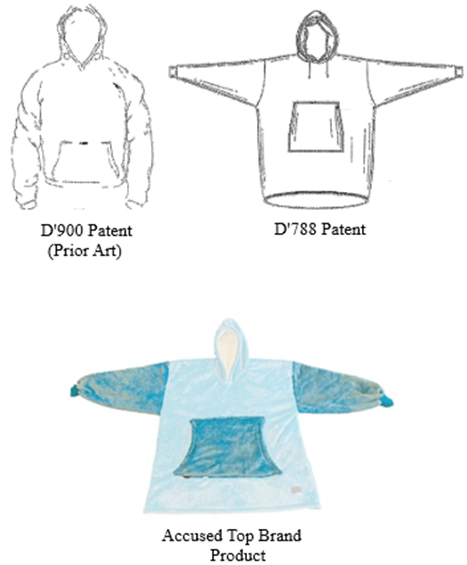
As shown above, the Top Brand sweatshirt includes a wider pocket that covers the majority of the width of the torso. The Top Brand sweatshirt also has more of a trapezoidal shape, similar to the D’900 Patent, compared to the squarer shape of the pocket in the D’788 Patent. Since Cozy Comfort used these differences to argue validity over the D’900 Patent during prosecution, these features also must be considered when construing the claim of the D’788 Patent during the infringement analysis of the accused Top Brand products. Based on this construction, the Federal Circuit found that no ordinary observer could find infringement by the accused Top Brand products.
Cozy Comfort also argued that Top Brand waived its claim construction argument by failing to object to the jury instruction at trial. However, a party does not waive a claim construction argument by failing to object at the jury instruction stage when the construction proposed on appeal is the same as the construction that was presented in earlier claim construction proceedings. Top Brand presented its preferred claim construction to the district court in its claim construction briefing. This construction was rejected in the district court’s claim construction order and rejected again at summary judgment in favor of Cozy Comfort’s construction. Since Top Brand has argued for the same claim construction on appeal that was argued to the district court, there is no waiver.
As for the issue of trademark infringement, the Federal Circuit overturned the jury’s finding that Top Brand infringed Cozy Comfort’s trademarks for THE COMFY. In particular, the Federal Circuit found insufficient evidence to show that Top Brand used a similar mark as THE COMFY as a source identifier. Cozy Comfort submitted evidence showing that Top Brand used the word “Comfy” on a website advertising Top Brand products. This website included a dropdown menu with a heading stating “Wearable Blanket” and included the term “Comfy” in a list of words describing the product. Cozy Comfort cannot remove the descriptive term “comfy” from the public domain without a showing of secondary meaning. The website only showed the use of the term “comfy” as a description and does not use the term as a trademark to identify source.

 Federal Circuit Precedential
Leave a comment