
Holding: A device does not infringe simply because it is possible to alter the device to meet all of the claim limitations. The device must be readily configurable to meet the claim limitations in order to infringe an asserted claim. The failure to obtain advice from a third party with respect to an allegedly infringed patent cannot be used to prove willfulness. The entire market value rule allows a larger component to be the royalty base for calculating damages if the patented feature is the basis for consumer demand for that larger component. However, only presenting conclusory expert testimony is not sufficient to prove that a patented feature is the basis for consumer demand.
Provisur owns several patents directed to food-processing machinery. In particular, US Pat. No. 7,065,936 describes a fill and packaging apparatus for loading sliced foods into packages. The asserted claim of the ‘936 Patent requires an apparatus that uses an advance-to-fill method of filling inserting sliced food into packaging. As shown in the diagram below, the advance-to-fill method starts with a conveyor in a retracted position and fills the packages closest to the slicer, and then advances to a fully extended position.
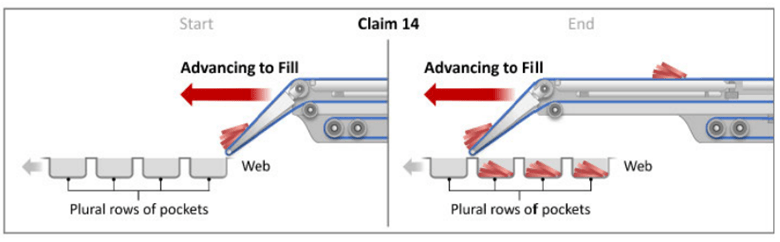
At the district court, a jury found that Weber’s SmartLoader products willfully infringed the ‘936 Patent and infringed several other Provisur patents. Weber moved for judgment as a matter of law (JMOL) on infringement and willfulness, and asked for a new trial on these issues, as well as damages, but these motions were denied.
With regard to infringement, Weber’s SmartLoader is sold to consumers as a retract-to-fill apparatus rather than an advance-to-fill apparatus. Provisur’s expert testified that the SmartLoader could be reprogrammed to be operated as an advance-to-fill conveyor by adjusting parameters on a human machine interface (HMI) of the SmartLoader conveyor. However, the Federal Circuit found this evidence to be insufficient to show infringement. An accused device infringes when it is reasonably capable of satisfying the claim limitations, but does not infringe just because it is merely possible to alter the device in a way to meet all the claim limitations. The device must be readily configurable to meet those claim limitations in order to infringe. In this case, Provisur’s expert had to access screens of the HMI that would not be accessible to a Weber customer in order to make the SmartLoader an advance-to-fill conveyor. Although the SmartLoader may be capable of being reprogrammed to be an advance-to-fill conveyor, this feature was not readily accessible; therefore, the Federal Circuit remanded the issue of infringement to the district court for further proceedings.
As to willfulness, Provisur’s damages expert was allowed to testify about Weber’s failure to consult a third party to evaluate the allegedly infringed ‘936 patent, specifically stating that Weber did not provide evidence that it had performed a freedom to operate analysis. The Federal Circuit found this testimony to violate 35 USC §298, which does not allow the failure of an infringer to obtain the advice of counsel to be used as evidence to prove willful infringement. Section 298 cannot be circumvented by discussing advice from a third party rather than advice of counsel. The Court further found that evidence that Weber tracked industry patents, including Provisur’s patents, to be insufficient to show willfulness. Simple knowledge of the patent-in-suit is not sufficient for a finding of willfulness, there must also be evidence of intent to infringe.
The Federal Circuit also reversed the district court’s denial of a new trial on damages. The accused Weber slicers are features of a larger component slicing apparatus. The damages award was based on Provisur’s reliance on the entire market value rule. Typically, royalties should be apportioned between infringing and noninfringing features of an accused product. To use an entire multi-component product as the royalty base, a patentee must prove that the patented feature is the basis for customer demand. Provisur used the value of the entire Weber slicing line as the royalty base, but only presented conclusory evidence to prove that the patented features drove the demand for the slicing line. Although in some cases expert testimony alone may be sufficient to invoke the entire market value rule, there must be something more than conclusory evidence to support the idea that the patent feature is driving customer demand.
Citation: Provisur Techs., Inc. v. Weber Inc., 119 F.4th 948 (Fed. Cir. 2024)

 Federal Circuit Precedential
Leave a comment